

Car Seat Safety
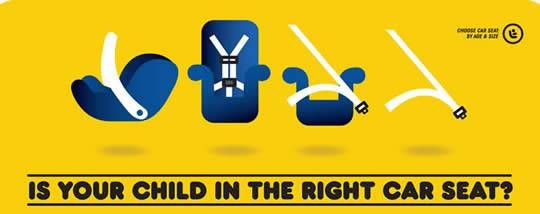
You’ve probably seen the billboards with the lineup of car seats and boosters, like the one pictured above, asking if your child is in the right one. As a father of four small children, I have seen the billboards but didn’t go to the website until recently.
Although most parents are aware their baby cannot be put in a forward-facing car seat until they are one year old and at least 20 pounds, the area seems to get a little fuzzy when it comes to switching from a car seat to a booster seat. The law itself is slightly ambiguous, as it says a child may move into a booster at “about 4 years old and 40 lbs.” That “about” leaves some room for interpretation. To add to the confusion, I noticed recently on our Graco booster that it says a child “must be approximately 3 to 10 years of age and weigh between 30 to 100 lbs.” My worry is that parents will read this and assume that their three-year-old is ready for a booster because they weigh 30 pounds.
As a Utah personal injury attorney, some of the most heartbreaking cases I have handled involve injuries to children who were in the wrong car seat or booster. I imagine that when a parent moves their child up to a booster before they are ready, it is for convenience’s sake, but I would hope that parents would take a more cautious approach. Accidents happen every day, and seatbelts and car seats save lives if used properly. When it comes down to it, small children are safer in a five-point harness until they are big enough and responsible enough to be in a booster.
The same goes for older children. They should be in a booster until they are at least 8 years old or 5’7″ and are responsible enough to keep their seatbelt properly positioned across their shoulder.